Authentic Texas: What Barbie taught me about homecoming mums in Texas
Originally published in Authentic Texas magazine, September 2026
“I’m stereotypical Barbie. I’m like the Barbie you think of when someone says, ‘Think of a Barbie.’ That’s me.”
– Margot Robbie as original Barbie in Barbie, 2023
For most of my primary school years, my Barbie doll and her friends were constant sources of entertainment and imagination. All I ever wanted for my birthday, or Christmas was to enhance my Barbie world-building.

Me on Christmas morning long ago. Note Barbie (or Skipper?) on a horse in the lower left-hand corner.
I don’t remember when I stopped playing with my Barbies because they are still with me in my fond memories.
When I first saw the Barbie (2023) movie, I both agreed and disagreed that Margot Robbie’s character was Stereotypical Barbie. Yes, the 1959 version of Barbie – the one Robbie portrayed – was the Original Barbie, but she was not my original Barbie. My Barbie didn’t have a high ponytail, wear a striped bathing suit or demurely look out of the corner of her eyes. My Barbie looked straight ahead, wore cool hairstyles and clothes, had a different career every day, and traveled in vehicles I couldn’t wait to someday drive or fly myself.
The Barbie doll of my childhood will always be the stereotypical kind to me. All the Barbies that came before and after remind me of her, but never the other way around. I imagine this is true for every child who loved any particular toy. That toy will always be Day One, even if its manufacturing date was decades after the first release.
Did it just hit you like it hit me?
Homecoming mums are just like Barbie.
The Dawn of Homecoming
When homecoming-like activities started taking place at U.S. colleges, then high schools, around the turn of the 20th century, they weren’t routinely called “homecoming” because that stereotype didn’t yet exist.

The first homecoming at the University of Michigan, for instance, took place in 1897. Called simply the “alumni game,” it pitted former football players against the varsity squad. It took years before the Wolverines used the term “homecoming” to describe a particular home-field football game plus associated activities like a parade and pep rally.
In Texas, the first schools to host similar homecomings were Baylor University and Southwestern University in 1909.
The first homecoming at the University of Michigan, for instance, is considered to be the first Alumni Game, which pitted former football players against the varsity squad in 1897. But it took some time before the Wolverines used the term homecoming to describe a particular “home vs. away” football game plus the events surrounding it.
In Texas, the first schools to use the word homecoming to describe similar events were Baylor University and Southwestern University in 1909.

Several fans at the 1913 University of Missouri homecoming game holding chrysanthemums
The Dawn of Homecoming Mums
The earliest versions of homecoming mums date back to at least the 1910s. Historically, this is not a surprise. Not only do chrysanthemums conveniently bloom in the fall during football season but they were considered quite stylish at the time. Still, even though chrysanthemums were readily available and popular, they were not yet the stereotypical homecoming flower. It takes time for something to become a stereotype.

Baylor University homecoming queen Marguerite Joyce, 1936
In this case, it took about three decades. Baylor University claims to have introduced the homecoming mum to Texas in the 1930s. By the early 1940s, chrysanthemum corsages became so strongly associated with homecoming across the U.S. that they became known simply as “mums.”
The Greatest Generation and the Silent Generation think this style of simple chrysanthemum corsage is the stereotypical homecoming mum.
What the Baby Boom did to Homecoming Mums in Texas
After World War II, Texas experienced a sustained population growth unmatched by almost any other state. During the 1950-51 school year, for example, the number of public school students in Texas totaled over 1.5 million. By the 1970-71 school year, that number had nearly doubled.
Double the students, double the homecoming mums! This was one of two boons for Texas florists. The other was that simultaneously, the post-war manufacturing boom began churning out new materials that made it easy to customize mums by high school. Imprinted ribbons in school colors became the norm as did small spirit charms (aka “trinkets”) and flourishes like high school monograms glued into the center of the flower.
Baby Boomers think this style of lightly decorated chrysanthemum corsage is the stereotypical homecoming mum.
Texas mums get personal
By the 1970s, the ever-expanding homecoming mum market in Texas was inspiring creativity, not only in design but unwritten protocols. One idea that eventually caught on statewide, for instance, was that the size of a mum reflected the wearer’s class year, with senior mums being the largest of all. Another innovation was garter mums for boys. New traditions like this eventually normalized large, elaborate mums as fashionable status symbols for everybody.

Coppell High School, 1980s (click for source)
This taste for larger mums was supercharged by 1980s maximalism (remember Sue Ellen Ewing’s massive shoulder pads on the TV show, Dallas?). No wonder this decade ushered in mums with longer ribbons, braided ribbons, bells, plush toys, and a new kind of customization that represented the student’s own activities in addition to generic symbols of school spirit.
Kids born at the end of the Baby Boom through Gen X think this style of customized chrysanthemum corsage is the stereotypical homecoming mum. This is my generation, so I say with certainty that much like my childlike feelings about Original Barbie vs. My Barbie, these Texans had no interest in wearing plain old mums like their mothers.’
Texas mums go from fleeting to keepsake

moms making mums, © Amy J. Schultz
The single-most important change in the evolution of homecoming mums in Texas began quietly in the 1960s. By the 1990s, there was no turning back. Homecoming mums went from being anchored by a live chrysanthemum flower to an artificial one.
An artificial flower is sturdy. You can sew, glue and staple things to it. It allows you to make mums in advance. It turns a perishable corsage into a lasting keepsake. Artificial flowers set homecoming mums on a creative trajectory beyond that of any corsage, and the experimentation continues to this day.
Artificial flowers also blew up the Texas mum monopoly held by florists. It took decades, but once moms and daughters finally internalized the advantages of artificial flowers, they started making mums themselves. Some were so good at it, they went into business. Since the 1970s, there has been an explosion of mum specialists—mostly in Texas and almost entirely women-owned—including wholesalers, distributors, dye sub printers, retailers, and thousands of home-based creators. And they do what they do out of love.
Kids of any generation who attended a school where artificial mums were the norm think this is the stereotypical homecoming mum. And unlike me and my opinions about Original Barbie, these kids don’t even know that Original Mum existed.
Texas mums today are bespoke

spidermum, © Amy J. Schultz
To describe Texas’ current mum era, I’m going to use a word from the past: bespoke. Centuries ago in ye merrie olde England, the verb bespeak meant to order something in advance. By the 1700s, the meaning of bespoke evolved into “custom-made” and was typically used to describe something you wear.
Bespoke mums. Yep, that is exactly what’s happening.
Notice I didn’t say that we are in an era of gigantic homecoming mums. Sure, today’s stereotypical mum is much larger than the stereotypical one from your high school days. But “gigantic” only describes the what. “Bespoke” describes the why.
Texas homecoming mums are considered. They’re influenced by fashion trends and social media. They go beyond customization; they’re a form of collaborative self-expression for the wearer, the maker and the giver. Designs range from luxe to ludicrous, girlie to goth, and believe it or not, massive to tiny. Some mums are exchanged between couples, others are gifts from friends or family, and some are created by the person wearing it. Whether professionally crafted, homemade, store bought, or upcycled, homecoming mums carry with them the traditions, culture, relationships, and stories which are all part of this uniquely Texan celebration.
When they’re in their forties, I wonder how Gen Alpha will describe their stereotypical homecoming mum? We’ll just have to wait to find out.

squad goals, © Amy J. Schultz
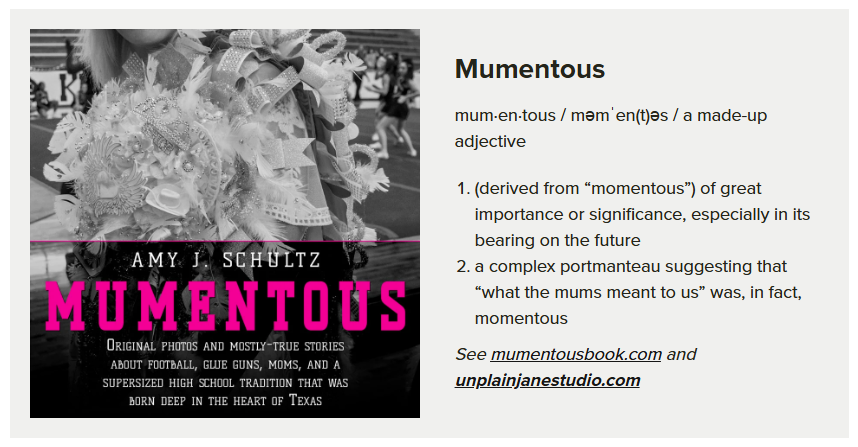
Take a deeper dive: MUMENTOUS
If you enjoyed reading this, check out my book MUMENTOUS, which is available in hard cover, eBook and audiobook formats. CLICK HERE for more info and links.
Excerpt from MUMENTOUS
“The humidity pushed down on the football stadium that homecoming night, capping and coagulating the din rising from the student section. Each individual sound, movement, and breath taken seemed to stick together in the atmosphere, forming a singular, dense mass of joyful disharmonies. I love it.
When I'm in a big crowd like this one, I play a game my mom taught me back when I was a wiggly child sitting next to her at a concert. First, she told me, find the sound of one instrument. The trumpet, maybe, or the piano. Listen to its melody until you can follow its story. Once understood, open your eardrums just a little in search of a complementary tone. Try to add a third, then a fourth. Take care you don't add too many storylines at once so that the first ones disappear back into the murk, because every instrument is equally important. As I applied her game to the homecoming-related chatter around me, there were so many harmonic stories from which to choose...”